Developments in the recent political landscape have gotten me to thinking a lot. Mostly, I’ve been thinking about how we can be so blinded by our own perspectives that we can forget what is most important. To begin, let me tell you a bit about one of my favorite movie clips. Have you ever seen I, Robot starring Will Smith? It’s generally a light action adventure movie that barely touches on the much deeper themes of existence that are front and center in the book by Isaac Asimov (Also, the plot is totally unrecognizable in the movie, so pick up the book and give it a read). Anyway, in the movie, there are multiple exchanges between Will Smith’s character and a pre-recorded holographic message of a murdered scientist (played by James Cromwell). As Smith asks questions, the recording often responds with “I’m sorry, but my responses are limited. You must ask the right questions.” When Smith’s character finally hits on the right question, the hologram proclaims:
“That, detective, is the right question.”
Interestingly, the hologram doesn’t provide an answer. The process of getting to the right question was the extent of its programming. Boy, do we need that hologram!
We often feel like we have the right answer, so anything and everything else can go out the window in service to that answer. Usually, this process occurs when we feel like we have a “big” answer – that is, a certain answer to one of life’s big questions. As I often tell my students, the big can be a distraction. It’s too general, too big; we’ll get lost in it. Make the question small; make the answer small. The big and the small have to fit together, so you can keep on track (admittedly, I follow Plato here).
Let’s take a big, controversial issue; for instance, let’s look at abortion (Technically, the controversy is usually about the legality of abortion, but let’s look further). Many people have strong positions here – both for and against. From the side of religion (which is all I’m qualified to speak about, I’m no lawyer), and Christianity in particular, the question on which the entire moral debate hangs is some version of this one: When does life begin? People line up with arguments (and often insults, vitriol, torches, and pitchforks) in defense of their perspectives on that question. On one side, the arguments are based on scientific evidence, yet often without the realization that it is a philosophical question. On the other side, the arguments are based on scriptures that are often made to bear the weight of interpretations they were never meant to convey – after all, you don’t get epistemological foundations from poetry (Psalm 139:13-16) or scientific fact from an analogical description of a mystical experience (Jeremiah 1:4-5). Still, I think the fault stems from the question.
We keep asking the wrong question because the right question is so much harder.
You see, let’s take a look at the interaction represented by the question: When does life begin?
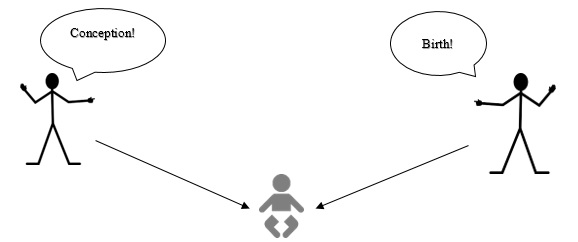
That’s not actually what’s happening in that situation. The “child” is hypothetical (Now, of course, actual people are always affected, but that is not how people are arguing about it. People are so much meaner when they are only talking “in theory”). In that situation, the actual situation looks like this:
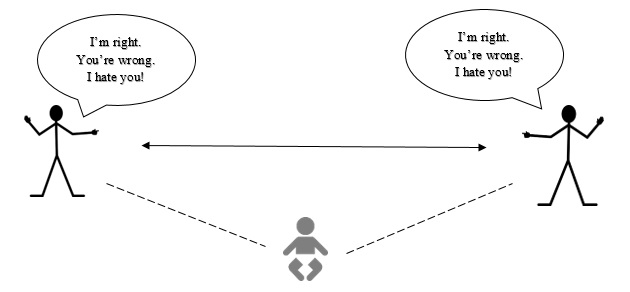
If that is the actual interaction, it’s easy to see that no one is going to be swayed by a battle of statistics vs. scripture. It’s also easy to see the right question: Who is my neighbor? (Luke 10:29)
This is a harder question because it is a question that Jesus actually answered. The answer is not about you or me; it’s about we. We always carry responsibility together, and our responsibility is to love. If Christians looked at the issue of abortion as we and us rather than they and them, then we might just change.
This perspective reaches further – to all of the recent political and moral issues that crop up, that always crop up.
Who is my neighbor? That, detective, is the right question.
But Dann…
If that is the question and Jesus’ answer is our answer, that would be devastating! We might be called to love those (on all sides!) who destroy, maim, and kill. We might even be called to love our enemies. And then what would happen to how right we are, how wrong they are?
Madoc