
Here is the fourth installment in my series on a case study of prayer beads as used (and interpreted) in multiple religious contexts. If you missed earlier installments, you can begin with the first section here.
General Discussion
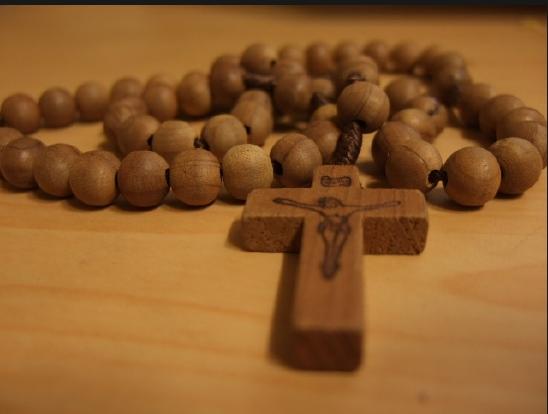
The foregoing history and sociology of the transmission of prayer beads from (1) one religion to another and from (2) one tradition to another within the scope of one religion illustrates that spiritual borrowing does indeed happen, and the form of the practice changes quite little comparatively. The number and size of beads varies. In some religions, some trinket is added to the strand of beads, such as a cross, pendant, or amulet. Still, the strand of beads does remain remarkably similar in all other ways. The fingering of beads as a means of counting, the repetitive nature of the process, and the encouragement to practice unobtrusively remains remarkably similar across nearly four thousand years of transmission. Most of the variety in the use of prayer beads from religion to religion comes through the prayers and theological purposes linked within each religion to the physical practice itself. For Hindus, it may be connected to the recitation of a long list of the names of certain gods, while Buddhists concentrate on eliminating desire through the recitation of the number of “sins” or attachments. Moving to the West, Christians count the number of petitions for mercy on their sins either from Christ directly (through the Jesus Prayer) or by the aid of the blessed Virgin (through the Rosary). Muslims invoke the attributes of Allah, as part of the action of submission through prayer. As we fast-forward to the present, the calm, peace, or personal ability to focus of the participant rises as a new central emphasis, lending an anthropological purpose to a practice that was historically explained in theological of soteriological terms alone. Still, we can observe that while the focus of prayers shifts, the practice remains remarkably the same. In fact, from an outside perspective, it is observable that the shape of the practice itself may serve to guide subtly the type of theology which eventually imbues it with purpose for a believer. Otherwise, how could we explain that both Buddhists and Christians focus on their mistakes or that Hindus and Muslims enumerate the names of God/gods?
History and sociology combine in close scrutiny of the borrowing of prayer beads to display a theological insight. Historical transmission of prayer beads from religion to religion shows two aspects of the borrowing process: behavior and belief. As a behavior, prayer bead usage changes remarkably little. In terms of belief, there is more latitude for explanation of the use of this particular spiritual practice by believers in each different religion. At this point, the sociological case study serves to clarify the relationship. My interviewees from the emergent church displayed a notable preference for borrowing the behavior first, and they either jettisoned or reinterpreted the theological purpose of the practice later according to their individual preferences. In other words, behavior is borrowed first – often with little more forethought than simple curiosity or utility – and belief catches up later. This progression of prayer bead borrowing shows two important insights which can be applied to the process of spiritual borrowing in general.
The first major insight of this examination is the neutrality of the container of spiritual practices. While not all spiritual practices may be as neutral as the use of prayer beads, it is clear that there is nothing within the practice itself which throws up obstacles for it to move from one religion to another. The boundaries of different religions – even religions that have spent millennia defining themselves in distinction from one another – are permeable. Prayer beads are used by Hindus, Buddhists, Christians, and Muslims for deeply theological and spiritual purposes while the religions themselves seem far apart. For example, on one hand, Christians connect the use of prayer beads to no smaller a theological doctrine than “God’s plan and work of redemption.”[1] While on the other hand, Muslims are connecting the use of prayer beads to their central doctrine of exaltation of Allah and their submission to him.[2] Prayer beads connect worshipers to their central beliefs from religions that are often antagonistic to each other – while using the exact, same spiritual practice! Unless the practice itself carried the quality of religious neutrality, such adaptability would be impossible. In fact, the Jewish use of prayer beads, without a theological focus at all, hints to the possibility of an even wider spiritual neutrality of the practice than discussed here.
A second insight comes into fuller relief through the sociological study of present-day spiritual borrowing. Specifically, the belief which allows for the borrowing of the “container” of a particular practice is not a theological belief at all; rather, it is a belief in pragmatism that allows for borrowing. The willingness on the part of a prayer practitioner to experiment – to try new things – with practices that might have origins with theological connections quite different from her/his faith tradition is the origin point of the borrowing. In other words, spiritual borrowing begins within an anthropological context before moving to a theological context. The neutrality of the container allows for remarkable elasticity with regard to theological content, and the long history of the use of prayer beads in practically every major world religion shows that there is no damage done to the theological content itself. So, the process of spiritual borrowing is a process of belief following behavior in which utility, curiosity, and practicality begin a process that ends in theology. Also, this progression is evident in both past and present directions. From the basis of these observations, I would like to propose a potential third direction: the future.
Past and present borrowing of spiritual practices display the neutrality of spiritual practices, and these borrowed practices are the tangible links connecting different religions on the level of action. These tangible links are difficult to see, for they are often only dimly visible beneath the vocal rhetoric of the impermeable boundaries of doctrinal belief. However, spiritual borrowing shows – with millennia of evidence – that on a practical level religious boundaries are permeable. While such an insight is theoretically interesting, it also has great potential for future methods of spiritual borrowing.
Most attempts in the past to form links among religious traditions, or at least promote religious tolerance, have focused on one of two lines of reasoning. Following one train of thought, these attempts at ecumenism appealed to the memory of a primordial unity, such as the common Abrahamic origins of the three monotheistic religions of the West. While such links often exist among religions, they depend on an appeal to connectedness that is essentially a family bond from several millennia ago. While blood is indeed thicker than water, the blood in this metaphor is practically fossilized. On the other thought track, ecumenical efforts have focused on appealing to the few theological and philosophical foundations of each religion that all would hold in common, such as: love, peace, or justice. The problem with these approaches is that they have hinged upon nebulous, abstract concepts that are very easy to skew toward one’s own personal interpretation when put into practice. What if the future of spiritual borrowing might also be the future of tolerance and cooperation among world religions? What if the future of ecumenism could be built on a foundation of behavior not belief? These directions are by no means inevitable or inescapable, but they do hold great promise if the religions of the world learn to see that they already do tolerate and cooperate with the others on the basis of practice, if not theory. No Christian picks up the Rosary with the thought that such a practice links him to a Hindu in prayer half a world away, but the concrete evidence of their shared prayer beads suggests that they are linked. That image, at least, should give us pause to consider.
[1]Agbasiere, “The Rosary,” 251.