
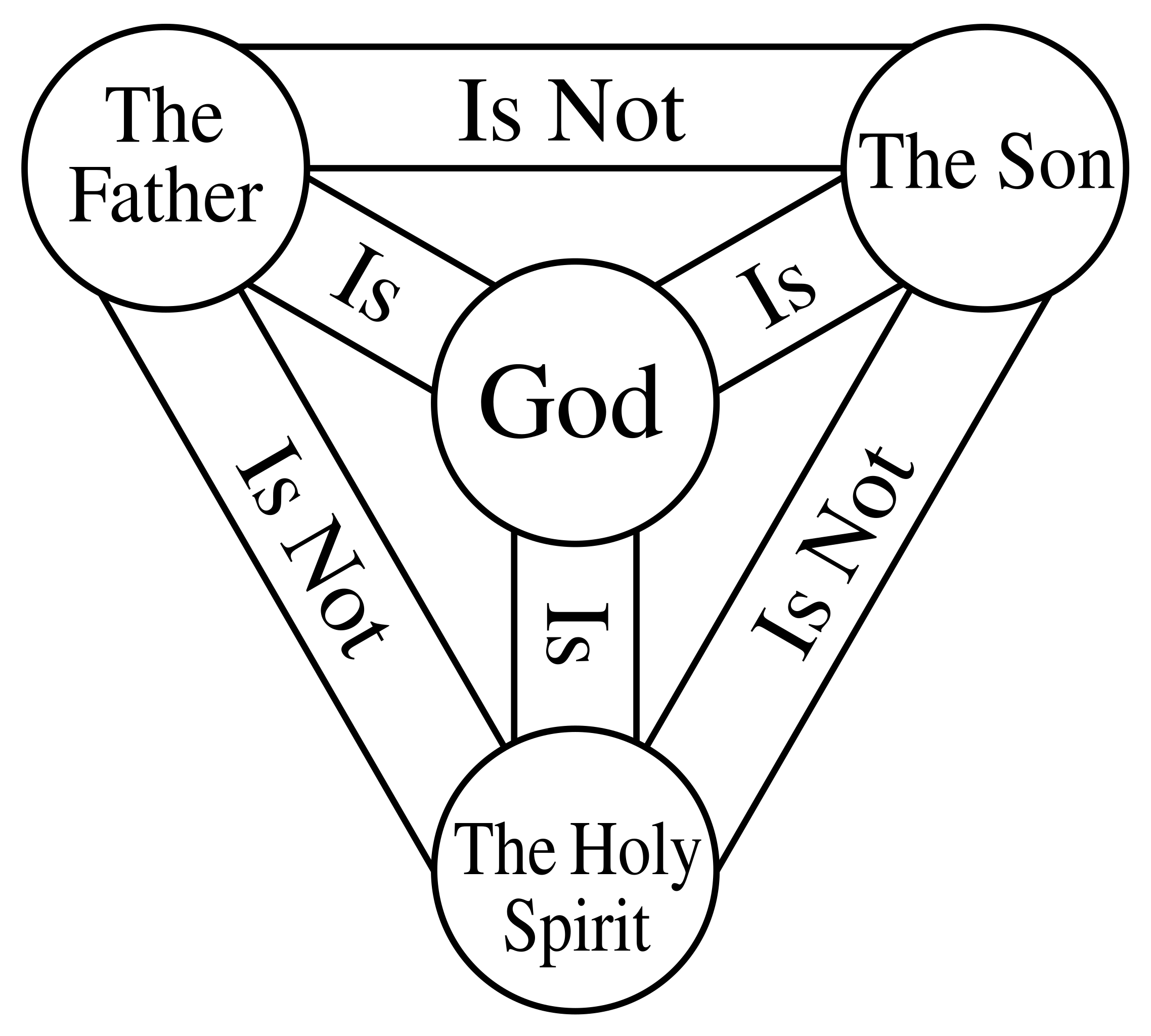
Just kidding!
Recently, I was teaching my eighth graders at All Saints Episcopal School in our Comparative Religion class about the distinctives of Christianity. Number one on that list is the doctrine of the Trinity. We puzzled around with it a bit. We talked about the term “modified monotheism” (as opposed to the “absolute monotheism” of Judaism and Islam). We talked about the uniqueness of Jesus. Eventually though, as all things do, it came down to math. Imagine the conversation going something like this:
“So, we have one God, right?”
“Yep.”
“But, we have the Father and the Son and the Holy Spirit, right?”
“Yep.”
“So, we have three gods, then?”
“Nope. We have three persons.”
“Uh-huh. So, is the Father the same is the Son?”
“Nope.”
“But, they are both God, right?”
“Sure.”
“How does that work? So, 1 = 3?”
“Yep, and 3 = 1.”
“I don’t get it. That doesn’t make sense.”
“Exactly! That’s the point. God is a Mystery.”
From that point (and I’m stretching the narrative a bit because it didn’t flow quite so easily), I started talking about how the three great monotheisms of the West – Judaism, Christianity, and Islam – all agree on one point: God is supreme. God is ultimate reality. There is no reality beyond God and what God has created. However, we are not supreme, so we can never completely understand God. God has to – has to – remain a Mystery to us, at least in part.
The interesting bit is that the three religions have come up with very interesting ways to acknowledge the Mystery and Supremacy of God that are constantly repeated every day by the followers of that religion. In these ways, God as Mystery is inescapable to us. We can’t not (I know, I know – double negative!) remember that God is Mystery due to these ways.
Well, then what are they?
For Jews, one must take great care to never use the personal name of God. Letters are omitted (sometimes, even in translation, such as with G_d) or substituted (“Lord” for “God” – which come from different Hebrew words). In fact, since Hebrew originally had no notation for vowels, the consonants used to denote the personal name of God do not actually have designated the specific vowels meant to go with them. That’s why both “Jehovah” and “Yahweh” are approximations for what vowel sounds might go in the right places. A God who cannot be named always remains in part a Mystery.
For Muslims, the key is present in the name of the religion itself: Islam. This name means “submission to God.” In fact, every Muslim who observes the daily times of prayer bows with head down to the ground in a very physical act of submission and recognition that God is above and beyond him or her. Submitting to God in this way reminds each individual Muslim that God is beyond, and a God beyond always remains in part a Mystery.
For Christians, our holiest doctrine is the Trinity, a doctrine that is not rational. Now, don’t misunderstand me. I do not mean that the Trinity is irrational because that would make God less than rational. The Trinity is transrational or suprarational because God contains the rational and then goes beyond the rational. Most Christians couple this, admittedly abstract, belief with a physical action. When we gather for the liturgy, each time that the words “Father, Son, and Holy Spirit” are said, we make the sign of the cross (at the very least, we’re supposed to make the sign of the cross at the opening and close of the liturgy when these words are spoken). This doctrine, these words, this action – in mind, spirit (which means breath by the way, which is what we use to form words), and body – we remember that God is a Mystery.
And, why the sign of the cross? Because, that Mystery, for Christians, is not really a word, a name, an action – that Mystery is a Person. Always a Person.