I like the Enneagram. I’ve written a little bit about it before here, and I’ve offered several workshops on it. Also, I’ve written about the Myers-Briggs Type Indicator (MBTI) here.
I’ve spent several years with both tools, reading and having endless conversations on their content, context, and utility.
I’d like to start sharing some insights I’ve had about the Enneagram.
First, let me explain my fascination with both the Enneagram and MBTI. I’m always on the lookout for a system or framework to understand people. As I’ve mentioned before, I’m autistic, and understanding other people has always been a struggle for me. Any tool that might make that task easier – that might give me a foundation to work with – is very attractive to me.
Then, I found MBTI (well, rediscovered – I took a test at some point back in college). It seemed like a useful tool to explain the different cognitive styles (i.e., ways of thinking) that people have. While MBTI has often been touted as a fuller system of “personality,” it is essentially a categorization of the order of thinking that people use to organize their internal and external world.
It is a helpful tool in getting to know others and working with them. For instance, I lead with the cognitive process called “Introverted Thinking.” Practically, this preference means that I ask “Why?” a lot. I go into situations seeking to understand matters (and people) logically. In fact, that is likely why I find a system for categorizing people interesting. It is also useful to know others cognitive processes. For instance, if I meet a person who leads with “Extroverted Thinking,” then I can expect (generally) that he or she is more concerned with questions of “What works?” over my abstract musings. Knowing our types would potentially help us work better and communicate better together.
On a personal level, knowing one’s MBTI type is helpful for realizing one’s own strengths and weaknesses, in what areas or careers one might find relatively more satisfaction, etc.
So, that’s the role of MBTI, more or less.
The Enneagram often gets treated in a similar way, with similar goals, but it is a different animal entirely.
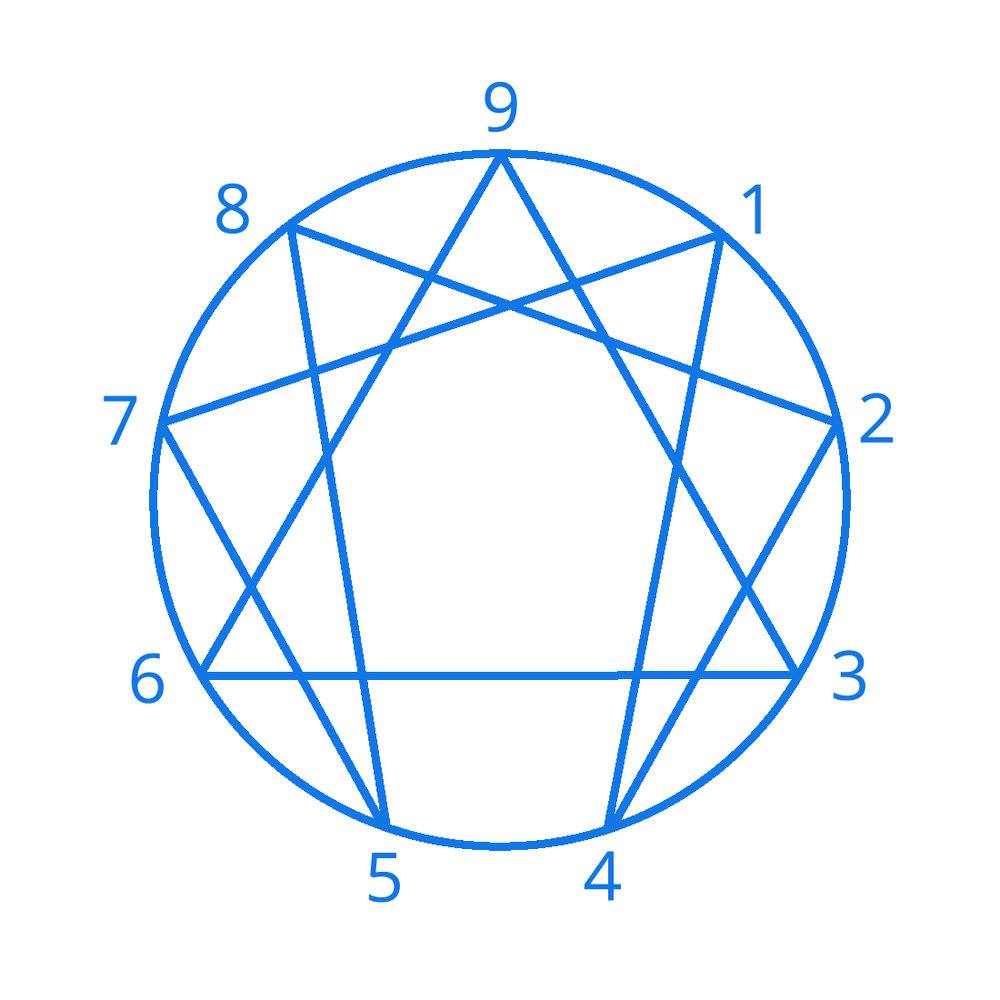
The Enneagram does differentiate people into nine types (as opposed to MBTI’s sixteen), and some of these types do correlate to certain distinctions in the MBTI system, which is why there is confusion, I suppose.
However, the purpose and direction of the systems are very different.
First, I was introduced to the Enneagram by my spiritual director. That should tell you something right there. The Enneagram is a spiritual tool; the MBTI is a psychological tool.
Second, the Enneagram is a very old tool. It was used by the Sufis in Islam who articulated this tool as nine types, but it was also used by Jewish Kabbalists in forming their ten-point Sefirot to explain the universe. Before either of these medieval uses, the Christian Desert Fathers and Mothers distilled the seven deadly sins from the insights of the Enneagram. By comparison, the MBTI, developed by Isabel Briggs Myers and Katharine Briggs and based on the book Psychological Types by Carl Jung, is practically brand new.
Third, and most importantly, the Enneagram is a tool for spiritual development not psychological description like MBTI. The point of the matter is not to tell someone, “I’m a Two” (or Five or Seven) with the expectation that the other will just learn to adjust to your idiosyncrasies. Finding one’s Enneagram Type is about discovering the specific path of how you hurt yourself (hence the connection to the deadly sins) and how you need to work to become free from these damaging “defense mechanisms.”
So, as this website is all about spirituality step-by-step, I would like to spend some significant time dealing with the Enneagram as a spiritual tool of self-knowledge and development toward the True Self. The Enneagram is a journey toward wholeness, so my hope is that you’ll journey with me as I delve into it over the next several posts.
As a retired editor-proof reader I get concerned with capital letters I do not understand. What words does MBTI represent?
These letters stand for Myers Briggs Type Indicator. Sorry for any lack of clarity on that front.
MBTI? What do these letters mean?